
Betadine: Uses, How It Works, Side Effects
Also known as: Betadine solution, Betadine antiseptic solution, Betadine 5%, Betadine liquid, Povidone iodine solution
Betadine solution is an iodine antiseptic that is put on the skin to help prevent infection in minor cuts, scrapes and burns. It contains povidone-iodine 5%. It is for external use only, and deep or dirty wounds and bites need a doctor.
- Active ingredient
- Povidone-iodine 5% w/v (VERIFY on pack)
- Type of medicine
- Antiseptics
- Used for
- Minor cuts and scrapes
- Starts working in
- Acts on germs on the skin soon after it is applied
- Effect lasts
- Applied 1 to 3 times a day on a minor wound; does not stay active for long on the skin
- With or without food
- Not applicable: it is for the skin only and is not swallowed
- Alcohol
- Not applicable for skin use
- Pregnancy
- Ask a doctor or pharmacist before use, because iodine can be absorbed through the skin
- Habit-forming
- No
- Made by
- VERIFY on pack
Pharmacist review in progress. This page is based on the sources listed below and is being checked by our registered pharmacist.
On this page
What is Betadine used for?
Betadine solution is used on the skin as a first-aid antiseptic. Check the pack for the uses printed on it.
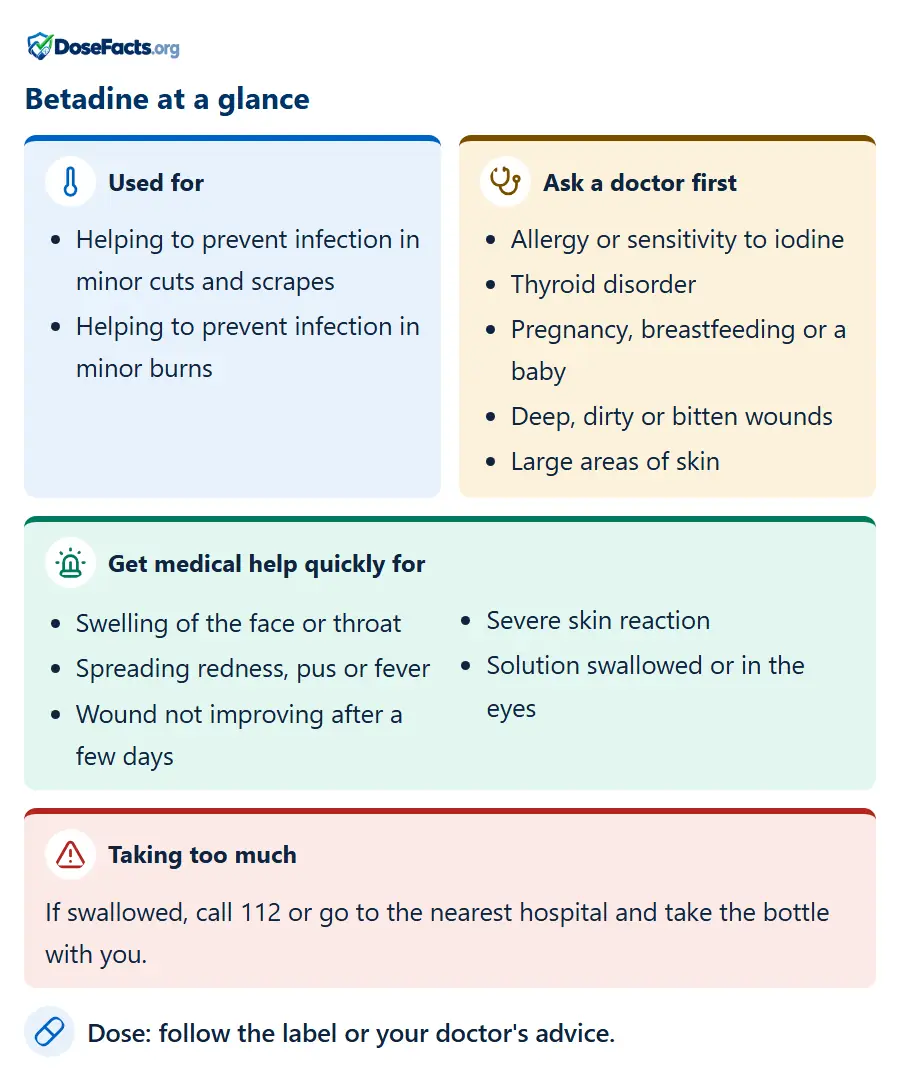
- Helping to prevent infection in minor cuts and scrapes
- Helping to prevent infection in minor burns
How does Betadine work?
Povidone-iodine slowly releases iodine, which damages the cells of bacteria, viruses and fungi on the surface of the skin. Fewer germs are left to cause infection in a minor wound.
What happens in your body after you take it
Clean the wound first
Rinse the area with clean water, as the NHS advises, and stop any bleeding by pressing on it with a clean cloth.
Apply a small amount
A small amount of the solution is put on the skin around and on the minor wound, as the pack says, and can be covered with a dressing once dry.
Iodine acts on germs
Iodine is released and damages bacteria and other germs on the skin surface.
The wound heals by itself
The body heals a minor wound. The antiseptic is stopped when the wound has healed, and it should not be used for longer than the label allows.
How to take Betadine
Follow the label or your doctor's advice. Betadine solution is for the skin only, and a small amount is applied to a clean minor wound.
- Clean the wound first, then apply a small amount, as the pack directs.
- US labels for povidone-iodine say 1 to 3 times a day; follow the label on your own pack.
- You can cover the area with a clean dressing once it is dry.
- Do not use it for longer than 1 week unless a doctor directs you to.
- Do not use it in the eyes or on large areas of the body.
Side effects of Betadine
Betadine solution is usually well tolerated on small areas of skin, but it can irritate some people.
Uncommon or mild
- Skin irritation, redness or itching where it is applied
- Brown staining of the skin that washes out
- A mild burning sensation
Rare but serious: get medical help
- Swelling of the face, lips, tongue or throat, rash all over, or difficulty breathing (a severe allergic reaction). Get medical help immediately
- A severe skin reaction, blisters or a burn-like area at the site
- Signs of infection getting worse: spreading redness, swelling, pus, increasing pain or fever
- Symptoms of a thyroid problem after repeated use on large areas or on babies: tiredness, weight changes or a fast heartbeat
Who should be careful
Betadine solution is for external use only, and some wounds need a doctor rather than an antiseptic.
- External use only: do not swallow it, and keep out of the eyes
- Do not use it over large areas of the body
- Do not use it longer than 1 week unless a doctor directs you to
- Deep or puncture wounds, animal bites and serious burns need a doctor
- Do not use it if you are sensitive or allergic to iodine
- Thyroid disorders: ask a doctor first, because iodine can be absorbed
- Pregnancy, breastfeeding and babies: ask a doctor first
- Stop and ask a doctor if the wound gets worse or does not improve
Medicines and things that interact with Betadine
Povidone-iodine can be affected by other products used on the same skin. Tell your doctor or pharmacist about what you use.
- Other antiseptics or skin products used on the same area: mixing them can reduce the effect or irritate the skin
- Mercury-containing products: they should not be used with iodine on the same area
- Thyroid medicines and thyroid tests: iodine absorbed through the skin can affect them; tell your doctor
If someone takes too much
If the solution is swallowed, get medical help or call a poison centre straight away. Call 112 or go to the nearest hospital and take the bottle with you. Using too much on the skin mostly causes irritation.
Storage
Store at room temperature, away from heat and sunlight, with the cap closed and out of the reach of children. Do not use after the expiry date. Check the pack for the exact storage instructions.
Regulatory status in India
Approved for sale in India. Single-ingredient povidone-iodine is not on the CDSCO list of medicines banned under section 26A of the Drugs and Cosmetics Act (checked in the extracted list text). Betadine solution contains povidone-iodine only; other Betadine products (ointment, gargle, scrub) are different products.
Other brands with the same medicine
Povidone-iodine antiseptic solution is sold under other brand names and as a generic. Strengths differ (for example 5% and 10%), so check the label. Ointment, scrub and gargle products are different and are not interchangeable.
Other strengths and forms
Betadine is sold in other forms, such as ointment, scrub, gargle and different strengths of solution. They are different products with different uses, so check the label of the one you have.
Common questions
What is Betadine solution used for?
It is used on the skin as a first-aid antiseptic to help prevent infection in minor cuts, scrapes and burns. It is for external use only. Deep wounds, animal bites and serious burns need a doctor.
Can I use Betadine on a deep or dirty wound?
No. Labels advise asking a doctor for deep or puncture wounds, animal bites and serious burns. Dirty wounds need cleaning with clean water and often a doctor's check, since a tetanus injection may be needed. An antiseptic does not replace medical care.
How long can I use Betadine on a wound?
Labels for povidone-iodine antiseptic say not to use it for more than 1 week unless a doctor directs. If the wound is not improving or is getting worse, stop and see a doctor.
Can Betadine be put in the eyes or swallowed?
No. The solution is for the skin only and must be kept out of the eyes. If it is swallowed, get medical help or call a poison centre straight away. Keep the bottle out of the reach of children.
Is Betadine safe for people with thyroid problems?
Ask a doctor first. Iodine can be absorbed through the skin, and the Betadine label warns of caution in thyroid disorders and says not to use it if you are sensitive to iodine. Babies and pregnant women should also ask a doctor before use.
Sources
- Povidone iodine solution, first aid antiseptic: OTC drug label. DailyMed, US National Library of Medicine
- Betadine 5% sterile ophthalmic prep solution (povidone-iodine): prescribing label (revised 6/2022). DailyMed, US National Library of Medicine
- Cuts and grazes. NHS (UK)
- List of drugs prohibited for manufacture and sale through gazette notifications under section 26A of the Drugs & Cosmetics Act 1940. Central Drugs Standard Control Organisation (CDSCO)
- ATC/DDD Index: D08AG02 povidone-iodine. WHO Collaborating Centre for Drug Statistics Methodology