
Duphalac: Uses, How It Works, Side Effects
Also known as: Duphalac syrup, Duphalac solution, Duphalac oral solution, Lactulose solution, Lactulose 10 g/15 mL
Duphalac is a liquid laxative containing lactulose, used to treat constipation and, under a doctor's care, a liver condition called hepatic encephalopathy. It softens stools by drawing water into the bowel. It can take 2 to 3 days to work.
- Active ingredient
- Lactulose 10 g per 15 mL
- Type of medicine
- Laxatives
- Used for
- Constipation
- Starts working in
- Can take 2 to 3 days to work
- Effect lasts
- Works while it is taken, and the effect fades after you stop
- With or without food
- Can be taken with or without food; follow the label or your doctor's advice
- Alcohol
- Alcohol does not interact directly, but drink plenty of other fluids as well; ask your doctor
- Pregnancy
- It can generally be used in pregnancy, but ask your doctor or pharmacist first
- Habit-forming
- No, but a laxative should be used only for a short time unless a doctor advises otherwise
- Made by
- VERIFY on pack
Pharmacist review in progress. This page is based on the sources listed below and is being checked by our registered pharmacist.
On this page
What is Duphalac used for?
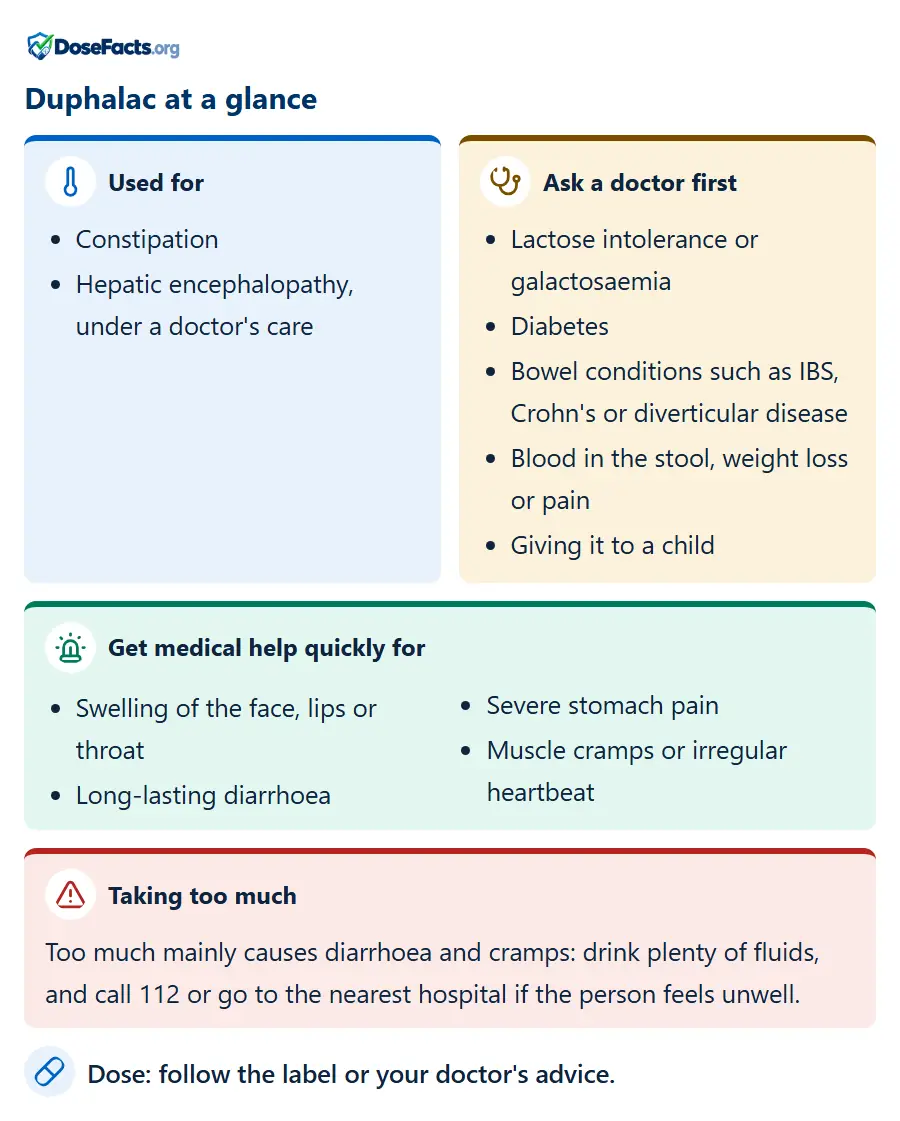
Duphalac is a laxative. It is used to treat constipation and, on a doctor's advice, hepatic encephalopathy, a brain condition that can occur in people with serious liver disease.
- Treating constipation (hard, dry or infrequent stools)
- Treating hepatic encephalopathy in people with serious liver disease, under a doctor's care
How does Duphalac work?
Lactulose is not absorbed in the upper gut, so it travels on into the bowel and draws water in with it. This softens the stool and makes it easier to pass.
What happens in your body after you take it
You take the liquid
Lactulose is swallowed as a sweet-tasting syrup. It can be mixed with water or juice.
It passes through the stomach and small intestine
The body cannot digest lactulose, so almost all of it moves on to the large bowel without being absorbed.
It draws water into the bowel
In the large bowel, lactulose holds on to water, so more fluid stays in the stool.
The stool softens
The softer, larger stool is easier to pass and moves through the bowel more easily. This can take 2 to 3 days.
Gut bacteria break it down
Bacteria in the large bowel break lactulose down into acids, which also helps draw in water. Some wind and bloating can occur at first.
How to take Duphalac
Take Duphalac exactly as your doctor has prescribed or as printed on the pack. Your doctor or the label decides the amount and for how long you need it.
- Measure the liquid with the cap or measuring spoon that comes with the pack, not a kitchen spoon.
- It can be taken with or without food, and may be mixed with water or juice. Follow the label or your doctor's advice.
- It can take 2 to 3 days to work, so do not take more because you have no effect on the first day.
- If you miss a dose, skip it and take the next dose at the usual time. Do not take two doses together.
- Drink plenty of fluids while taking it. See a doctor if constipation does not improve after about 3 days.
Side effects of Duphalac
Most people have only mild side effects, which often ease after a few days.
Uncommon or mild
- Wind (gas), which should ease after a few days
- Bloating
- Stomach ache
- Feeling sick (nausea) or being sick (vomiting)
- Diarrhoea
Rare but serious: get medical help
- Swelling of the face, lips, tongue or throat, or difficulty breathing (a severe allergic reaction). Get medical help immediately
- Long-lasting diarrhoea, which can lead to dehydration and low potassium, with weakness, muscle cramps or an irregular heartbeat
- Severe stomach pain or vomiting that does not settle
Who should be careful
Some people need to check with a doctor before taking Duphalac, or need extra care while taking it.
When the label says not to use it
- A blocked bowel (not caused by constipation)
- Galactosaemia
- Allergy to lactulose
- Lactose intolerance, galactosaemia, or allergy to galactose or fructose: the syrup contains small amounts of these sugars
- Bowel conditions such as irritable bowel syndrome, diverticular disease or Crohn's disease: ask your doctor first
- A blocked bowel that is not caused by constipation: do not use it
- Diabetes, especially at high doses for liver problems: it can affect blood sugar
- Constipation with blood in the stool, weight loss, pain or a sudden change in bowel habit needs a doctor's check
- Children: do not give to a child unless a doctor has advised it
- Pregnancy and breastfeeding: it can generally be used, but ask your doctor or pharmacist first
Medicines and things that interact with Duphalac
Few specific interactions are listed for lactulose. Tell your doctor or pharmacist about everything you take.
- Other laxatives: using several together can cause diarrhoea and loss of body salts
- Some medicines, remedies and supplements may not mix well with lactulose; check the leaflet or ask a pharmacist
If someone takes too much
Taking too much Duphalac mainly causes diarrhoea, stomach cramps and loss of fluid. Drink plenty of fluids. If someone has taken much more than prescribed, or feels unwell, call 112 or go to the nearest hospital and take the pack with you.
Storage
Store below 30 C in a dry place, protected from light, with the cap closed, and out of the reach of children. Do not use after the expiry date. The syrup can darken or thicken slightly in cold; check the pack for the exact storage instructions.
Regulatory status in India
Approved for sale in India. Whether Duphalac is sold on prescription or over the counter must be read from the pack. Single-ingredient lactulose was not found on the CDSCO list of banned medicines in the text checked for this batch. Duphalac contains lactulose only.
Other brands with the same medicine
Lactulose solution is sold under other brand names and as generic medicines. They contain the same medicine; check the label for the strength per 15 mL. Do not switch between products without asking your doctor or pharmacist.
Other strengths and forms
Lactulose is sold in different strengths and bottle sizes, and sometimes as a powder or sachets. The strength is printed on the pack and may not be the same across products, so check the label of the one you have.
Common questions
What is Duphalac used for?
Duphalac is a laxative for constipation. A doctor may also prescribe it for hepatic encephalopathy, a brain condition in people with serious liver disease. Use it as the label or your doctor advises, with plenty of fluids.
How long does Duphalac take to work?
It can take 2 to 3 days to work, so one dose may not bring quick relief. See a doctor if constipation is not better or is getting worse after about 3 days.
Can I take Duphalac in pregnancy?
It can generally be used in pregnancy and while breastfeeding, but ask your doctor or pharmacist first. Fibre, fluids and activity are the first steps for constipation in pregnancy.
Can I take Duphalac if I have diabetes?
Ask your doctor. Lactulose syrup contains small amounts of sugars, and at high doses it can affect blood sugar. Do not change your diabetes medicines on your own.
Can I take Duphalac every day?
Only if your doctor advises. Laxatives are meant for short-term use. If you need one often, see a doctor to find the cause. If it was prescribed for a liver condition, do not stop without asking your doctor.
What should I do if I miss a dose of Duphalac?
Skip the missed dose and take the next one at the usual time. Never take two doses together to make up for a missed one.
What is the difference between Duphalac and Lactulose solution?
Duphalac is a brand name, and lactulose is the medicine inside it. Generic lactulose solution contains the same active ingredient. Check the strength per 15 mL on the pack, and ask your pharmacist before switching.
Sources
- Lactulose: a laxative for constipation. NHS (UK)
- Constipation. NHS (UK)
- ATC/DDD Index: A06AD11 lactulose. WHO Collaborating Centre for Drug Statistics Methodology
- List of drugs prohibited for manufacture and sale through gazette notifications under section 26A of the Drugs & Cosmetics Act 1940. Central Drugs Standard Control Organisation (CDSCO)