
Uniwarfin 5: Uses, How It Works, Side Effects
Also known as: Uniwarfin, Uniwarfin 5 mg, Uniwarfin 5 tablet, Warfarin 5 mg, Warfarin sodium 5 mg
Uniwarfin 5 is a prescription tablet containing 5 mg of warfarin, an anticoagulant (blood thinner) used to treat and prevent harmful blood clots, for example in the legs or lungs, and to lower the risk of stroke in people with some heart conditions. Bleeding is its main risk, so regular INR blood tests are needed. It must never be started, stopped or changed without a doctor's advice, and every doctor and dentist should be told you take it.
- Active ingredient
- Warfarin 5 mg
- Type of medicine
- Anticoagulants
- Used for
- Blood clots
- Starts working in
- The full effect on clotting takes a few days to build up, so the dose is adjusted using blood tests
- Effect lasts
- The effect continues for a few days after the last dose, which is why it is taken once a day and checked by blood tests
- With or without food
- Can be taken with or without food; follow the label or your doctor's advice
- Alcohol
- Avoid large amounts of alcohol; ask your doctor
- Pregnancy
- Usually avoided, because it can harm the developing baby; a specialist may use it in special cases; tell your doctor at once if you are or may be pregnant
- Habit-forming
- No
- Made by
- VERIFY on pack
Pharmacist review in progress. This page is based on the sources listed below and is being checked by our registered pharmacist.
On this page
- What is Uniwarfin 5 used for?
- How does Uniwarfin 5 work?
- How to take Uniwarfin 5
- Side effects of Uniwarfin 5
- Who should be careful
- Medicines and things that interact with Uniwarfin 5
- If someone takes too much
- Storage
- Regulatory status in India
- Other brands with the same medicine
- Other strengths and forms
- Common questions
What is Uniwarfin 5 used for?
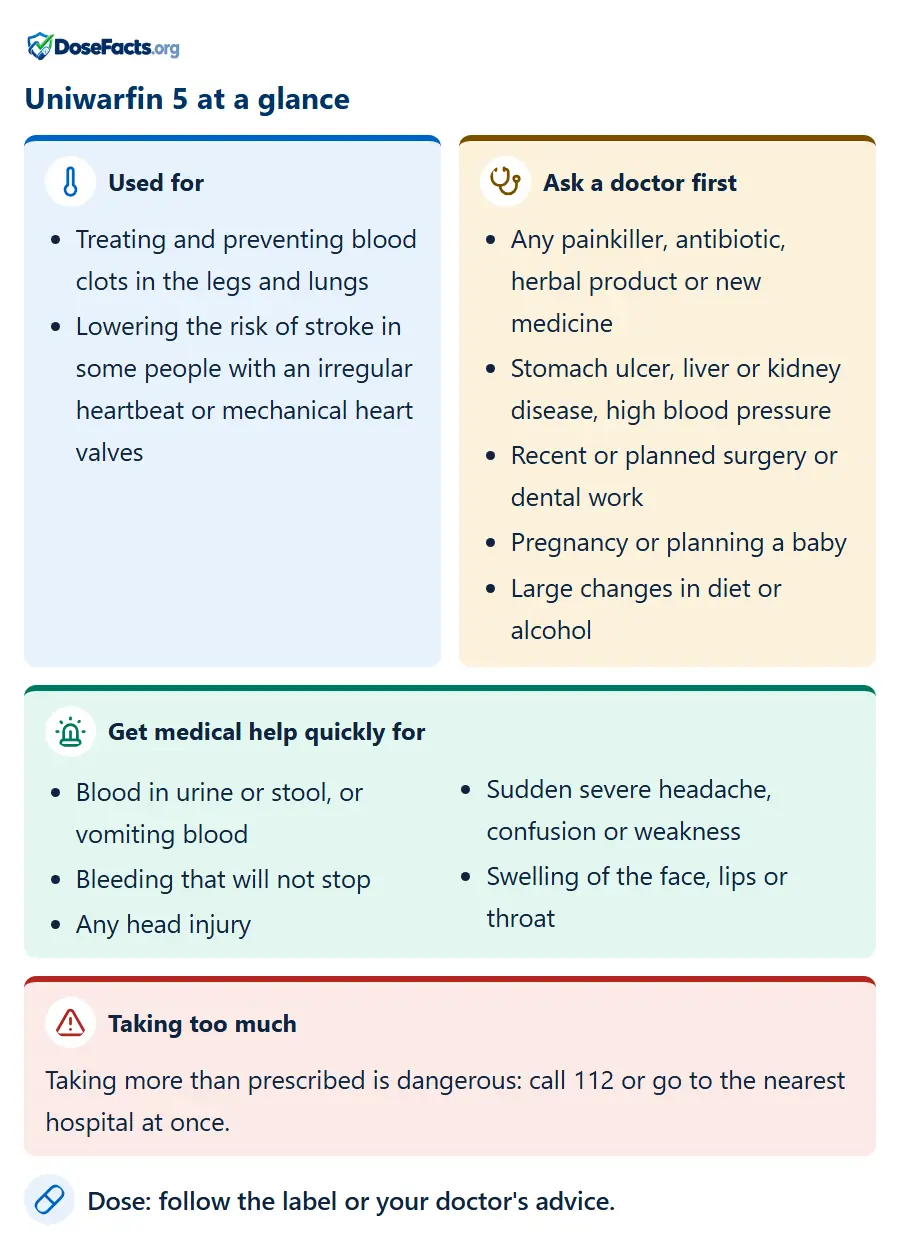
Uniwarfin 5 is a prescription medicine. It is used, on a doctor's advice, to treat and prevent blood clots and to lower the risk of clot-related stroke in some people.
- Treating and preventing blood clots in the veins of the legs (deep vein thrombosis) and in the lungs (pulmonary embolism)
- Lowering the risk of clots and stroke in people with an irregular heartbeat called atrial fibrillation, or with mechanical heart valves
- Other conditions in which a doctor judges the blood is clotting too easily
How does Uniwarfin 5 work?
The liver needs vitamin K to make several of the proteins that make blood clot. Warfarin blocks the way the body re-uses vitamin K, so these proteins are made in a less active form and the blood takes longer to clot. Doctors check this with a blood test called the INR.
What happens in your body after you take it
You swallow the tablet
The tablet dissolves in the gut and warfarin is absorbed into the blood. It can be taken with or without food.
It travels in the blood
Warfarin is carried around the body attached to blood proteins and reaches the liver, where clotting proteins are made.
It blocks vitamin K recycling
In the liver, warfarin stops the body from re-using vitamin K, which the clotting proteins need to become active.
Clotting slows
Over a few days, less active clotting protein is available, so clots are less likely to form or grow. The INR blood test shows how long the blood takes to clot.
The body clears it
Warfarin is broken down by the liver and removed in the urine and stool. Food rich in vitamin K, illness, alcohol and many other medicines can change its effect, which is why regular blood tests are needed.
How to take Uniwarfin 5
Take Uniwarfin 5 exactly as your doctor or warfarin clinic has told you. The dose is different for each person and is changed using INR blood tests, so never change it yourself.
- It is usually taken once a day at the same time each day, with or without food.
- INR blood tests are done often at the start, then at regular intervals. Do not miss them.
- If you miss a dose, take it when you remember on the same day. If it is already the next day, skip the missed dose and take the usual dose. Never take two doses together. Tell your warfarin clinic if you often miss doses.
- Keep your diet steady. Foods rich in vitamin K, such as spinach, broccoli and other leafy greens, can change the effect, so do not make big changes without asking your doctor.
- Carry your anticoagulant alert card, and tell every doctor, dentist and pharmacist that you take warfarin.
Side effects of Uniwarfin 5
Bleeding is the main risk of warfarin. Some bleeding is minor, but some needs urgent medical help.
Uncommon or mild
- Easy bruising
- Nosebleeds or bleeding gums
- Bleeding from cuts that takes longer to stop
- Heavier periods
Rare but serious: get medical help
- Blood in the urine or stool (red or black, tarry stool), or vomiting or coughing up blood. Get medical help immediately
- A sudden severe headache, confusion, trouble speaking, weakness or vomiting (possible bleeding in the brain). Call 112 or get emergency help immediately
- Any head injury or heavy fall, even if you feel well. Get medical help
- Bleeding that does not stop, or large unexplained bruises
- A painful skin rash or dark patches on the skin
- Swelling of the face, lips, tongue or throat, or difficulty breathing (a severe allergic reaction). Get medical help immediately
Who should be careful
Some people need to check with a doctor before taking Uniwarfin 5, or need extra care while taking it.
When the label says not to use it
- Allergy to warfarin or any ingredient of the tablet
- Active serious bleeding
- Pregnancy, unless a specialist has advised it
- Never stop it, or change the dose, on your own: stopping can raise the risk of a clot or stroke. Talk to your doctor first
- Bleeding risk: tell your doctor about stomach ulcers, liver or kidney disease, high blood pressure, a recent stroke, recent or planned surgery, or any condition that raises bleeding risk
- Pregnancy: warfarin can harm the developing baby and is usually avoided; tell your doctor at once if you are pregnant or planning a baby, and do not stop it without advice
- Breastfeeding: it is generally allowed, but tell your doctor if your baby has unexplained bruising or blood in urine, stool or vomit
- Avoid contact sports and activities with a high risk of injury where possible
- Surgery, tooth extraction or any procedure: tell the doctor or dentist beforehand that you take warfarin
- Alcohol: avoid large amounts
Medicines and things that interact with Uniwarfin 5
Warfarin interacts with a very large number of medicines, foods and supplements, and its effect can change. Tell your doctor, pharmacist and warfarin clinic about everything you take or plan to take, including herbal remedies and painkillers bought over the counter.
- Painkillers such as aspirin, ibuprofen, diclofenac and other NSAIDs: they raise the risk of bleeding. Ask before using any painkiller; paracetamol is generally the one doctors suggest, but check first
- Other blood thinners and antiplatelet medicines: the risk of bleeding rises
- Some antibiotics, antifungals, antidepressants, heart medicines, ulcer medicines and statins: they can raise or lower the effect, so the INR may need checking
- Herbal and supplement products such as St John's wort and vitamin K: can change its effect
- Foods rich in vitamin K, and cranberry or grapefruit juice: can change its effect; keep intake steady
- Alcohol: large amounts can change its effect and raise the risk of bleeding
If someone takes too much
Taking more than prescribed is dangerous because it can cause serious bleeding. If someone has taken more than prescribed, call 112 or go to the nearest hospital at once and take the medicine pack and alert card with you.
Storage
Store below 30 C in a dry place, protected from light and moisture, in the original strip, and out of the reach of children. Do not use after the expiry date. Check the pack for the exact storage instructions.
Regulatory status in India
Approved for sale in India as a prescription medicine. Single-ingredient warfarin is not known to be on the CDSCO list of medicines banned under section 26A of the Drugs and Cosmetics Act. Uniwarfin 5 contains warfarin sodium only (confirm on the pack).
Other brands with the same medicine
Warfarin 5 mg tablets are sold under other brand names and as generic medicines. They contain the same medicine, but warfarin comes in several strengths with different tablet colours. Never switch brand or strength without asking your doctor or warfarin clinic.
Other strengths and forms
Warfarin is sold in several strengths. The strength is printed on the pack and is not the same across products, so check the label of the one you have and never mix strengths without your doctor's advice.
Common questions
Is Uniwarfin 5 a prescription medicine?
Yes. Warfarin is a prescription medicine in India. It should be taken only if a doctor has prescribed it, and it should never be started, stopped or changed without the doctor's advice. Regular INR blood tests are needed.
What is Uniwarfin 5 used for?
It is used to treat and prevent harmful blood clots, such as in the leg or lung, and to lower the risk of stroke in some people with an irregular heartbeat or mechanical heart valves. Your doctor decides if it suits you.
Why do I need INR blood tests on Uniwarfin 5?
The INR shows how long your blood takes to clot. Warfarin works differently for each person and is affected by food, illness and other medicines, so the test helps keep the effect safe. Do not miss tests.
What should I do if I bleed or hit my head on Uniwarfin 5?
Get medical help straight away for bleeding that will not stop, blood in urine or stool, vomiting blood, or any head injury, even if you feel fine. A sudden severe headache or confusion is an emergency. Show your alert card.
Can I stop Uniwarfin 5 if I feel well?
No. Do not stop on your own. Stopping can raise the risk of a clot or stroke. Talk to your doctor, who decides whether any change is suitable.
Can I take painkillers with Uniwarfin 5?
Painkillers such as aspirin and ibuprofen raise the risk of bleeding. Ask your doctor or pharmacist before taking any painkiller or new medicine, including herbal products, and tell every doctor that you take warfarin.
Does food matter with Uniwarfin 5?
Yes. Leafy green vegetables are rich in vitamin K and can change warfarin's effect. You can still eat them, but keep your diet steady and ask your warfarin clinic. Avoid cranberry and grapefruit juice and large amounts of alcohol.
What is the difference between Uniwarfin 5 and warfarin 5 mg?
Uniwarfin is a brand name, and warfarin is the medicine inside it. Generic warfarin 5 mg tablets contain the same active ingredient. Never switch brand or strength without asking your doctor, because the INR may need rechecking.
Sources
- Warfarin: an anticoagulant medicine. NHS (UK)
- Blood clots and deep vein thrombosis (DVT). NHS (UK)
- ATC/DDD Index: B01AA03 warfarin. WHO Collaborating Centre for Drug Statistics Methodology