
Clotrimazole: Uses, How It Works, Medicines
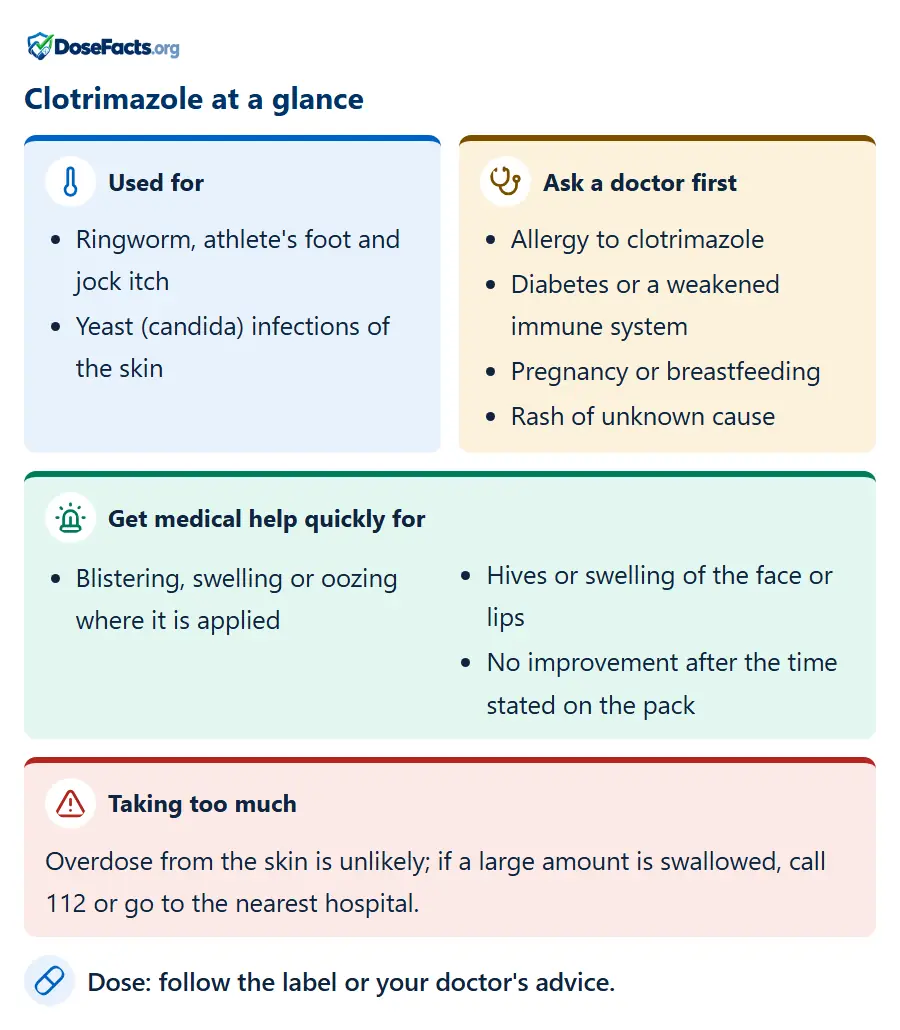
Clotrimazole is an antifungal medicine applied to the skin to treat fungal and yeast infections such as ringworm, athlete's foot, jock itch and skin candidiasis. It works only on fungi and yeasts, not on bacteria or viruses. It is used on the skin for the full time advised, even when the skin looks better.
Also known as: Clotrimazole 1% cream, Clotrimazole cream, Candid, Canesten, Lotrimin
Pharmacist review in progress. This page is based on the sources listed below and is being checked by our registered pharmacist.
How does Clotrimazole work?
Clotrimazole is an azole antifungal. It damages the outer layer (membrane) of fungal and yeast cells so they cannot grow, which lets the skin clear.
How to take Clotrimazole
Follow the label or your doctor's advice. The cream is usually rubbed in gently on the affected skin and a little of the skin around it, and it is used for the whole time advised even if symptoms ease.
Side effects of Clotrimazole
Clotrimazole cream is usually well tolerated. Side effects are mostly local to the skin.
Uncommon or mild
- Redness, stinging or burning
- Itching
- Peeling or irritation of the skin
Rare but serious: get medical help
- Blistering, swelling or oozing at the site, which can mean a sensitivity. Stop using it and tell a doctor
- Hives or swelling of the face, lips or throat. Get medical help immediately
Who should be careful
Some people need extra care with clotrimazole cream.
When the label says not to use it
- Allergy to clotrimazole or to any ingredient of the cream
- Not for the eyes
- Avoid airtight dressings or wrappings over the cream unless a doctor says so
- See a doctor if there is no improvement after about four weeks, if the rash spreads, or if you have diabetes or a weakened immune system
- Used on the genital area, the cream can damage latex condoms and diaphragms
- Pregnancy and breastfeeding: ask a doctor or pharmacist first
Medicines and things that interact with Clotrimazole
Used on the skin, clotrimazole is not known to interact with many medicines. Tell your doctor or pharmacist what else you use on your skin.
- Other creams or steroid creams on the same area: use only if a doctor advises, because a steroid can make some fungal infections worse
- Latex condoms and diaphragms: the cream may weaken them
If someone takes too much
Overdose from skin use is unlikely and would not be expected to be life-threatening. If someone swallows a large amount, call 112 or go to the nearest hospital and take the pack with you.
Regulatory status in India
Clotrimazole 1% cream is sold in India as an antifungal. Single-ingredient clotrimazole is not on the CDSCO list of medicines banned under section 26A, but many fixed-dose combinations that contain clotrimazole with steroids, antibiotics or other ingredients are on that list, so always check the ingredient list on the pack.
Type of medicine
Clotrimazole belongs to this type of medicine.
Medicines that contain Clotrimazole
These medicines sold in India contain Clotrimazole. They are listed A to Z, not ranked.
- Candid Cream · 1% skin cream
What is Clotrimazole used for?
Medicines that contain Clotrimazole are used for these conditions.
Other medicines of the same type
These active ingredients are of the same type as Clotrimazole.
Common questions
What is clotrimazole cream used for?
Clotrimazole cream is used on the skin for fungal and yeast infections such as ringworm, athlete's foot, jock itch and candida skin infections. It does not work on bacterial or viral rashes. Ask a doctor or pharmacist if you are unsure what is causing the rash.
How long should I use clotrimazole cream?
Use it for the full time stated on the pack or by your doctor, even if the skin looks better. The US label says to tell a doctor if there is no improvement after four weeks. Stopping early can let the infection come back.
Does clotrimazole cream contain a steroid?
Plain clotrimazole cream does not. Some other creams combine clotrimazole with a steroid and sometimes an antibiotic, and many such combinations are banned in India. Check that the pack lists clotrimazole only.
Sources
- Clotrimazole cream USP, 1%: prescribing information (Glenmark, revised 5/2025). DailyMed, US National Library of Medicine
- Clotrimazole 1% vaginal and external cream: Drug Facts (Taro, NuCare pack). DailyMed, US National Library of Medicine
- Athlete's foot. NHS (UK)
- Ringworm. NHS (UK)
- ATC/DDD Index: D01AC01 clotrimazole. WHO Collaborating Centre for Drug Statistics Methodology
- List of drugs prohibited for manufacture and sale through gazette notifications under section 26A of the Drugs & Cosmetics Act 1940. Central Drugs Standard Control Organisation (CDSCO)