
Rabeprazole: Uses, How It Works, Medicines
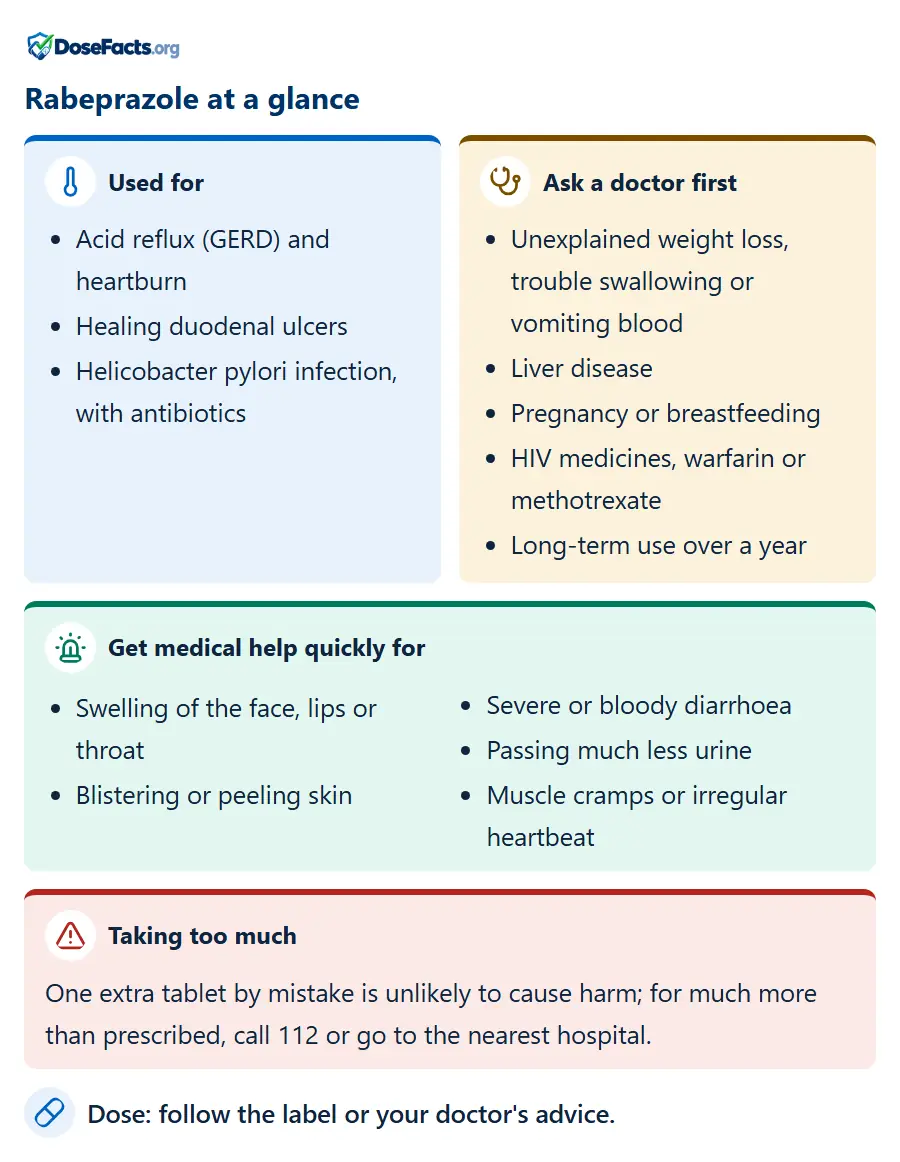
Rabeprazole is a proton pump inhibitor (PPI), a medicine that lowers the amount of acid the stomach makes. It is used to treat acid reflux (GERD) and duodenal ulcers, and, with antibiotics, Helicobacter pylori infection. In India it is a prescription medicine.
Also known as: Rabeprazole 20 mg, Rabeprazole sodium, Rabeprazole tablet, Rabeprazole IP, Razo, Rabicip, Pariet, Proton pump inhibitor, PPI, Acidity tablet
Pharmacist review in progress. This page is based on the sources listed below and is being checked by our registered pharmacist.
How does Rabeprazole work?
Rabeprazole blocks the acid pump (H+/K+ ATPase) in the stomach lining cells, which is the last step in making stomach acid. The effect lasts much longer than the medicine stays in the blood, so it is usually taken once a day.
How to take Rabeprazole
Follow the label or your doctor's advice. Rabeprazole tablets are swallowed whole, not chewed or crushed, and the strength and number of weeks depend on the condition being treated. Ask your doctor to review it if you have been taking it for months.
Side effects of Rabeprazole
Most people take rabeprazole without problems, and side effects are usually mild. A few rare risks are linked mainly to long-term use.
Uncommon or mild
- Headache
- Stomach pain, wind or constipation
- Diarrhoea
- Feeling sick (nausea)
- Dizziness or dry mouth
- Sore throat
Rare but serious: get medical help
- Signs of a severe allergic reaction: swelling of the face, lips or throat, difficulty breathing or a sudden widespread rash. Get medical help immediately
- A serious skin reaction: red skin with blisters or peeling, or sores in the mouth
- Watery or bloody diarrhoea that does not go away, with cramps or fever, which can be a sign of a gut infection (C. difficile)
- Passing less urine, blood in the urine, or fever with a rash, which can be signs of kidney inflammation
- A rash on skin exposed to the sun, with joint pain, which can be a sign of a lupus-type reaction
- Muscle cramps, twitching, an irregular heartbeat or confusion, which can be signs of low magnesium
Who should be careful
Rabeprazole can ease symptoms that come from a more serious problem, and it can cause problems when taken for a long time.
When the label says not to use it
- Allergy to rabeprazole, other proton pump inhibitors (substituted benzimidazoles) or any ingredient of the tablet
- Treatment with the HIV medicine rilpivirine
- Warning signs that need a doctor's check first: unexplained weight loss, difficulty swallowing, repeated vomiting, vomiting blood or black stools. Relief of symptoms does not rule out stomach cancer
- Long-term use (a year or more): it can lower vitamin B12 and magnesium, weaken bones and slightly raise the risk of fractures and gut infections. Your doctor may review whether you still need it
- Liver disease and low magnesium: tell your doctor
- Pregnancy or breastfeeding: ask your doctor or pharmacist first
- Children: the 20 mg strength is not for young children; follow your doctor's advice
- A planned endoscopy or a chromogranin A blood test: rabeprazole may need to be paused beforehand, so tell the doctor
Medicines and things that interact with Rabeprazole
Rabeprazole lowers stomach acid, so it can change how some medicines work. Tell your doctor or pharmacist about everything you take.
- Rilpivirine (an HIV medicine): must not be combined
- Atazanavir and nelfinavir (HIV medicines): rabeprazole can lower their levels, so the combination is avoided or adjusted by the doctor
- Warfarin: clotting tests (INR) may be needed more often
- Methotrexate in high doses, digoxin and tacrolimus: their levels may rise, so your doctor may monitor them
- Medicines that need stomach acid to be absorbed, such as ketoconazole, itraconazole and iron tablets: they may work less well
- Clopidogrel: a small reduction in its active form has been seen; ask your doctor if you take it
If someone takes too much
Taking one extra tablet by mistake is unlikely to cause harm. If someone has taken much more than prescribed, or feels unwell, call 112 or go to the nearest hospital and take the medicine pack with you.
Regulatory status in India
Approved for sale in India as a prescription medicine. Single-ingredient rabeprazole is not on the CDSCO banned list text checked, but several fixed-dose combinations that include rabeprazole are prohibited, for example with diclofenac and paracetamol or with zinc and domperidone, so check the ingredient list on the pack.
Type of medicine
Rabeprazole belongs to this type of medicine.
Medicines that contain Rabeprazole
These medicines sold in India contain Rabeprazole. They are listed A to Z, not ranked.
- Razo 20 · 20 mg gastro-resistant (enteric-coated) tablet
What is Rabeprazole used for?
Medicines that contain Rabeprazole are used for these conditions.
Other medicines of the same type
These active ingredients are of the same type as Rabeprazole.
Common questions
What is rabeprazole used for?
Rabeprazole is a prescription medicine that lowers stomach acid. It is used to treat acid reflux (GERD), duodenal ulcers, and, with antibiotics, Helicobacter pylori infection. Your doctor decides whether it suits you and for how long.
Should rabeprazole be taken before or after food?
Practice differs by condition. Labels say duodenal ulcer treatment is taken after a meal, H. pylori treatment with food, and other uses with or without food. Follow the label or your doctor's advice and swallow the tablet whole.
Can I take rabeprazole for a long time?
Only if your doctor advises and reviews it. Long-term use is linked to low vitamin B12 and magnesium, weaker bones and gut infections. Many people need it only for a few weeks. Do not stop a prescribed course on your own.
Is rabeprazole different from pantoprazole or omeprazole?
They are all proton pump inhibitors that work in the same way and are used for similar conditions. They differ in strength, interactions and how they are broken down in the body. Do not swap one for another without asking your doctor.
Sources
- Rabeprazole sodium delayed-release tablets: prescribing information (Amneal). DailyMed, US National Library of Medicine
- ATC/DDD Index: A02BC04 rabeprazole. WHO Collaborating Centre for Drug Statistics Methodology
- List of drugs prohibited for manufacture and sale through gazette notifications under section 26A of the Drugs & Cosmetics Act 1940. Central Drugs Standard Control Organisation (CDSCO)