
Colcin: Uses, How It Works, Side Effects
Also known as: Colcin 0.5 mg, Colcin tablet, Colchicine 0.5 mg
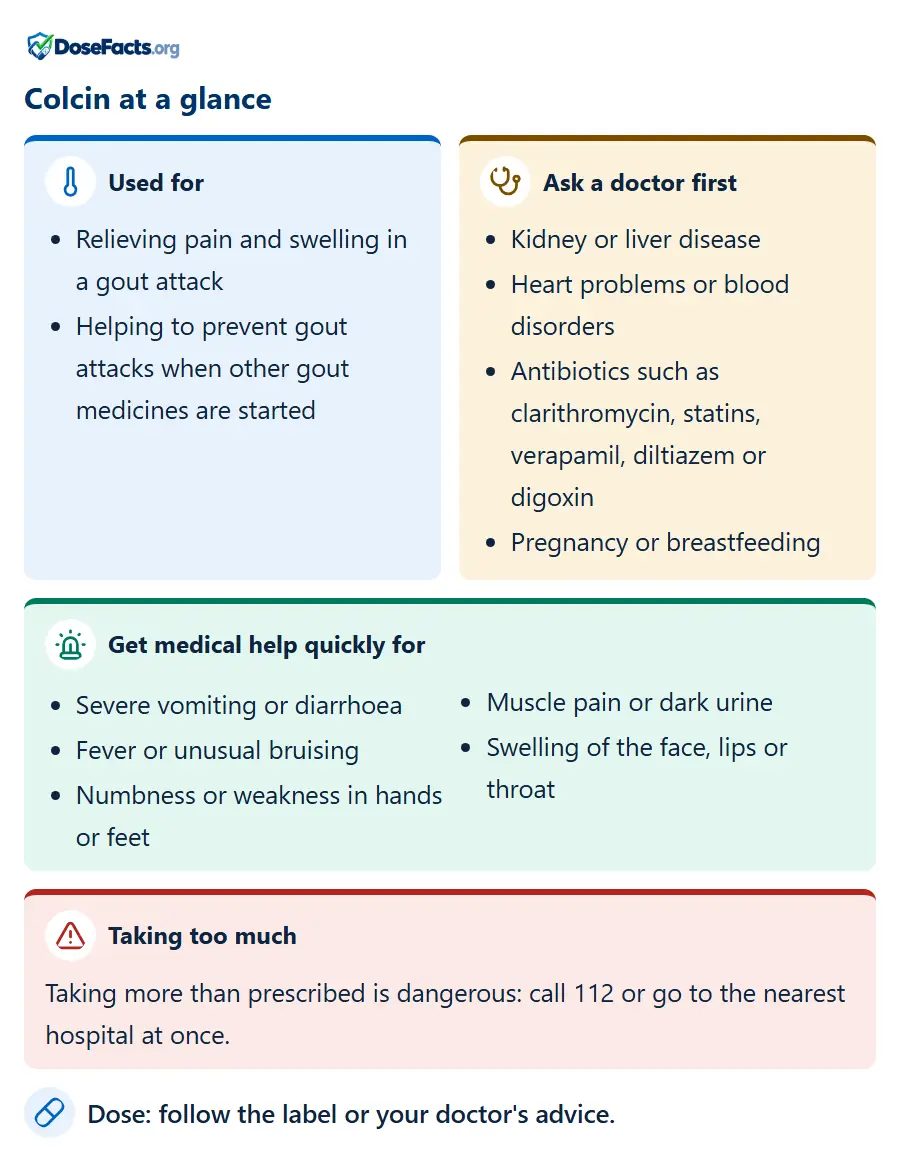
Colcin is a prescription tablet containing 0.5 mg of colchicine, used to relieve pain and swelling in gout attacks and, in some people, to help prevent attacks when other gout medicines are started. It is a different kind of medicine from uric acid-lowering tablets such as allopurinol. Taking more than the prescribed amount can be dangerous, so it should be taken exactly as the doctor says. It should only be started or stopped on a doctor's advice.
- Active ingredient
- Colchicine 0.5 mg
- Type of medicine
- Anti-gout medicines
- Used for
- Gout
- Starts working in
- Pain and swelling in a gout attack usually begin to ease within about a day
- Effect lasts
- Used for short periods during an attack or while other gout medicine is started; follow the label or your doctor's advice
- With or without food
- Can be taken with or without food; follow the label or your doctor's advice
- Alcohol
- Alcohol can trigger gout attacks; ask your doctor
- Pregnancy
- Can be used if needed after the doctor weighs risks and benefits; tell your doctor if you are or may be pregnant
- Habit-forming
- No
- Made by
- VERIFY on pack
Pharmacist review in progress. This page is based on the sources listed below and is being checked by our registered pharmacist.
On this page
What is Colcin used for?
Colcin is a prescription medicine. It is used, on a doctor's advice, to relieve gout attacks and to help prevent attacks in some people.
- Relieving pain and inflammation in a gout attack
- Helping to prevent gout attacks while a uric acid-lowering medicine is being started, when a doctor judges it suitable
- Preventing symptoms of a rare inherited condition called familial Mediterranean fever, when prescribed
How does Colcin work?
In a gout attack, uric acid crystals in the joint attract white blood cells, which cause pain, heat and swelling. Colchicine reduces the activity of these white blood cells, which eases the inflammation. It does not lower the amount of uric acid in the blood.
What happens in your body after you take it
You swallow the tablet
The tablet dissolves in the gut and colchicine is absorbed into the blood. It can be taken with or without food.
It reaches the white blood cells
Colchicine moves into white blood cells, which gather around uric acid crystals in an inflamed joint.
It calms the inflammation
It interferes with the way these cells move and release inflammatory chemicals, so they cause less swelling and pain.
Pain and swelling ease
The hot, swollen, painful joint usually begins to settle within about a day. The crystals are still there, so uric acid itself is controlled with other medicines.
The body clears it
Colchicine is cleared by the liver and kidneys and from the gut. If the doses are too close together or kidneys or liver are weak, it can build up to a harmful level, which is why the doctor sets the timing.
How to take Colcin
Take Colcin exactly as your doctor has prescribed or as printed on the pack. Do not take doses closer together than prescribed, because colchicine can build up to dangerous levels.
- Your doctor decides how many tablets to take, how far apart, and for how long. Follow the label or your doctor's advice.
- It can be taken with or without food.
- Never take extra tablets to speed up relief. Too much can cause severe stomach upset, bone marrow problems and organ damage.
- If you miss a dose, take it when you remember. If it is almost time for the next dose, skip the missed one. Do not take two doses together.
- Avoid grapefruit and grapefruit juice, which can raise the level of colchicine.
Side effects of Colcin
Colchicine often upsets the stomach first, and that can be a sign that the amount in the body is too high. Some side effects need medical help.
Uncommon or mild
- Stomach pain
- Feeling sick (nausea) or vomiting
- Diarrhoea
Rare but serious: get medical help
- Severe or persistent vomiting, stomach pain or diarrhoea (possible toxicity). Contact a doctor straight away
- Fever, unusual bruising or bleeding that does not stop (possible bone marrow problems)
- Numbness, tingling, pain or weakness in the hands or feet (possible nerve damage)
- Muscle pain or weakness, or dark urine (possible muscle or kidney problems)
- Swelling of the face, lips, tongue or throat, an itchy rash or difficulty breathing (a severe allergic reaction). Get medical help immediately
Who should be careful
Some people need to check with a doctor before taking Colcin, or need extra care while taking it.
When the label says not to use it
- Allergy to colchicine or any ingredient of the tablet
- Taking more than the prescribed amount
- Kidney disease or dialysis: colchicine can build up in the body
- Liver disease or heart problems
- Blood disorders
- Digestive conditions such as a stomach ulcer, Crohn's disease, ulcerative colitis or coeliac disease
- Pregnancy: it can be used if needed after the doctor weighs the risks and benefits; tell your doctor if you are pregnant or planning a baby
- Breastfeeding: it may be possible, but ask a doctor or pharmacist first
- Taking more than prescribed can be life-threatening
- If you feel drowsy or dizzy, avoid driving
Medicines and things that interact with Colcin
Colcin can be harmful when taken with some other medicines, because they can raise the level of colchicine in the body. Tell your doctor or pharmacist about everything you take, including herbal remedies.
- Some antibiotics such as clarithromycin and erythromycin: they can raise colchicine to dangerous levels
- Statins (cholesterol medicines): the risk of muscle problems may rise
- Verapamil and diltiazem (heart medicines), digoxin, ciclosporin, cimetidine and ritonavir: may interact
- Grapefruit juice: can raise the level of colchicine to harmful amounts; avoid it
- Alcohol: can trigger gout attacks
If someone takes too much
Taking more than prescribed is dangerous and can cause severe vomiting, diarrhoea, and damage to the blood, muscles, nerves and kidneys. If someone has taken more than prescribed, call 112 or go to the nearest hospital at once and take the medicine pack with you. Do not wait for symptoms.
Storage
Store below 30 C in a dry place, protected from light and moisture, in the original strip, and out of the reach of children. Do not use after the expiry date. Check the pack for the exact storage instructions.
Regulatory status in India
Approved for sale in India as a prescription medicine. Single-ingredient colchicine is not known to be on the CDSCO list of medicines banned under section 26A of the Drugs and Cosmetics Act. Colcin contains colchicine only (confirm on the pack).
Other brands with the same medicine
Colchicine 0.5 mg tablets are sold under other brand names and as generic medicines. They contain the same medicine; check the label for the strength. Do not switch products or combine brands without asking your doctor.
Other strengths and forms
Colchicine is sold in other strengths and, in some products, with other medicines. The strength and contents are printed on the pack, so check the label of the one you have.
Common questions
Is Colcin a prescription medicine?
Yes. Colchicine is a prescription medicine in India. It should be taken only if a doctor has prescribed it, and it should not be started, stopped or changed without the doctor's advice. It can be dangerous in larger amounts than prescribed.
What is Colcin used for?
It is used to relieve the pain and swelling of a gout attack and, in some people, to help prevent attacks when other gout medicines are started. It does not lower uric acid itself. Your doctor decides if it suits you.
Is it safe to take extra Colcin for a bad gout attack?
No. Taking more than prescribed or doses closer together can cause serious poisoning, with severe vomiting, diarrhoea and damage to blood, muscles and kidneys. Contact your doctor if the pain is not controlled.
Does Colcin lower uric acid?
No. Colchicine eases the inflammation of gout but does not lower uric acid. Medicines such as allopurinol or febuxostat do that. Ask your doctor how the medicines fit together.
Why does Colcin cause stomach upset?
Nausea, stomach pain and diarrhoea are common and can be an early sign that too much is in the body. Contact your doctor promptly if they are severe or do not settle, and do not take more tablets.
Can I drink grapefruit juice with Colcin?
No. Grapefruit juice can raise the level of colchicine in the blood to harmful amounts. Some antibiotics, heart medicines and statins have a similar effect, so tell your doctor everything you take.
What is the difference between Colcin and colchicine 0.5 mg?
Colcin is a brand name, and colchicine is the medicine inside it. Generic colchicine 0.5 mg tablets contain the same active ingredient. Check the strength and ingredient list on the pack, and ask your doctor before switching.
Sources
- Colchicine: a medicine to treat gout. NHS (UK)
- Gout. NHS (UK)
- ATC/DDD Index: M04AC01 colchicine. WHO Collaborating Centre for Drug Statistics Methodology