
Imodium: Uses, How It Works, Side Effects
Also known as: Imodium 2 mg, Imodium capsule, Imodium capsules, Loperamide 2 mg, Imodium loose motion capsule
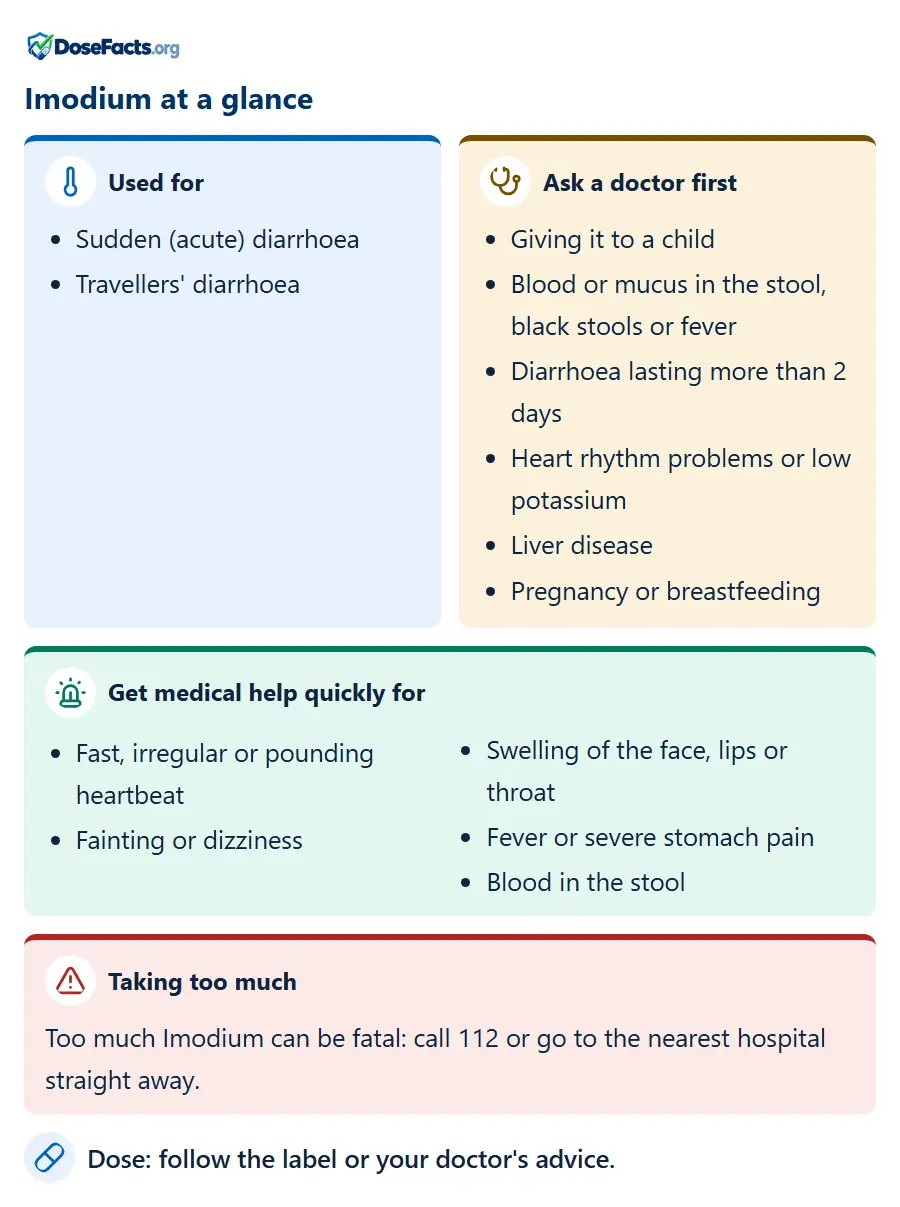
Imodium is a capsule containing 2 mg of loperamide, used to treat sudden (acute) diarrhoea, including travellers' diarrhoea. It slows the gut so stools become firmer. It is not for young children, and not for bloody diarrhoea or diarrhoea with fever. Taking more than the label allows can cause serious heart problems. Drinking fluids and oral rehydration solution (ORS) remains the main treatment.
- Active ingredient
- Loperamide 2 mg
- Type of medicine
- Antidiarrhoeals (anti-diarrhoea medicines)
- Used for
- Diarrhoea
- Starts working in
- Usually within a few hours of a dose
- Effect lasts
- A few hours; follow the label for how often it can be repeated
- With or without food
- Can be taken with or without food; follow the label or your doctor's advice
- Alcohol
- Alcohol can add to drowsiness and dehydrate you; ask your doctor
- Pregnancy
- Ask your doctor before taking it
- Habit-forming
- No
- Made by
- VERIFY on pack
Pharmacist review in progress. This page is based on the sources listed below and is being checked by our registered pharmacist.
On this page
What is Imodium used for?
Imodium is used for short-term treatment of sudden diarrhoea. It treats the symptom, not the cause, and does not replace fluids.
- Treating sudden (acute) diarrhoea in adults and older children, as stated on the pack
- Treating travellers' diarrhoea
How does Imodium work?
Loperamide acts on the wall of the gut to slow the movement of its contents. The bowel then has more time to absorb water, so stools become firmer and less frequent.
What happens in your body after you take it
You swallow the capsule
The capsule dissolves in the stomach and loperamide moves into the gut.
It acts on the gut wall
Loperamide attaches to receptors in the wall of the intestine. Very little of it enters the rest of the body at normal doses.
The gut slows down
The muscles of the bowel move more slowly, so stool spends longer in the gut.
More water is absorbed
With more time, the bowel absorbs more water from the stool, which becomes firmer. You may pass stools less often.
The liver clears it
Loperamide is broken down by the liver and removed mainly in the stool. Taking more than the label allows can let too much enter the body and affect the heart.
How to take Imodium
Take Imodium exactly as printed on the pack or as your doctor has advised. Never take more than the label allows, and stop and see a doctor if diarrhoea lasts longer than 2 days.
- Swallow the capsule with water. It can be taken with or without food.
- Do not take more than the amount or number of days on the pack. High doses can cause serious heart problems.
- Drink plenty of fluids while you have diarrhoea. Use oral rehydration solution (ORS) if there are signs of dehydration.
- If you miss a dose, skip it and take the next one only if you still need it and the label allows. Do not take two doses together.
- Stop and see a doctor if diarrhoea lasts longer than 2 days, gets worse, or comes with fever, blood or severe stomach pain.
Side effects of Imodium
Most people have few side effects when loperamide is used as directed. The serious risks are mainly linked to taking too much.
Uncommon or mild
- Constipation
- Tiredness
- Drowsiness or dizziness
- Wind or stomach discomfort
- Feeling sick (nausea)
Rare but serious: get medical help
- Swelling of the face, lips, tongue or throat, wheezing, difficulty breathing or a widespread rash (a severe allergic reaction). Get medical help immediately
- A fast, irregular or pounding heartbeat, dizziness or fainting. Get medical help immediately
- Fever, a swollen or very painful stomach, or blood in the stool
- Red, peeling or blistering skin
Who should be careful
Some people should not take Imodium, and others need to check with a doctor first.
When the label says not to use it
- Children below the age stated on the pack
- Diarrhoea with blood in the stool or with a high fever
- A swollen, painful stomach or suspected bowel blockage
- Allergy to loperamide
- Children: not for young children. Check the age limit on the pack, and ask a doctor before giving it to any child. Children can become dehydrated quickly, so give ORS and see a doctor early
- Blood or mucus in the stool, black stools, or fever: do not take it; see a doctor, because slowing the gut can make some infections worse
- Diarrhoea that lasts longer than 2 days or is getting worse: stop and see a doctor
- Never take more than the label allows: high doses can cause serious heart rhythm problems that can be fatal
- Heart rhythm problems (such as long QT or a slow or irregular heartbeat) or low potassium: ask your doctor first
- Diarrhoea after taking antibiotics, or with severe stomach pain or a swollen stomach: see a doctor before using it
- Liver disease: ask your doctor first
- Pregnancy or breastfeeding: ask your doctor first
- Drowsiness and dizziness: take care driving or using machinery until you know how it affects you
Medicines and things that interact with Imodium
Some medicines raise the level of loperamide in the body, which can raise the heart risk. Tell your doctor or pharmacist about everything you take.
- Medicines that affect the heart rhythm: the risk of a heart rhythm problem may rise
- Some medicines that slow the breakdown of loperamide, such as certain antifungals, macrolide antibiotics and gemfibrozil: ask your doctor or pharmacist
- Opioid painkillers and other medicines that cause constipation or drowsiness: the effects may add up
If someone takes too much
Taking more Imodium than the label allows can cause nausea, fainting, an irregular heartbeat, confusion and slow or shallow breathing, and can be fatal. Call 112 or go to the nearest hospital straight away and take the medicine pack with you.
Storage
Store below 30 C in a dry place, protected from light and moisture, in the original strip, and out of the reach of children. Do not use after the expiry date. Check the pack for the exact storage instructions.
Regulatory status in India
Approved for sale in India. Single-ingredient loperamide capsules are not on the CDSCO list of banned medicines in the text checked for this batch. Liquid antidiarrhoeals for paediatric use containing loperamide, and loperamide combinations with furazolidone (or furazolidone and metronidazole), are prohibited under section 26A, so check the ingredient list on the pack. Imodium contains loperamide only.
Other brands with the same medicine
Loperamide 2 mg capsules are sold under other brand names and as generic medicines. They contain the same medicine; check the label for the strength. Some other products with a similar name or diarrhoea combinations contain different medicines, so do not switch without asking your doctor or pharmacist.
Other strengths and forms
Loperamide is sold in different forms, such as capsules, quick-dissolve tablets and liquids, and in some products with other medicines. The strength and contents are printed on the pack, so check the label of the one you have. Liquid loperamide for children is not permitted in India.
Common questions
What is Imodium used for?
Imodium is used for sudden (acute) diarrhoea, including travellers' diarrhoea. It slows the gut and makes stools firmer. It does not treat the infection that may be causing the diarrhoea, and it does not replace lost fluids.
Can I give Imodium to a child?
Not without a doctor's advice. It is not for young children, and the age limit is printed on the pack. Children can become dehydrated quickly. Give ORS and fluids and see a doctor early.
Can I take Imodium if there is blood in the stool or fever?
No. Blood or mucus in the stool, black stools or fever can mean a bacterial infection, and slowing the gut may make it worse. See a doctor instead of taking Imodium.
Why must I not take more Imodium than the label says?
High doses of loperamide can cause dangerous heart rhythm problems and can be fatal. Never take more than the label or your doctor advises. If you have taken too much, call 112 or go to a hospital at once.
Should I drink ORS while taking Imodium?
Yes. Diarrhoea removes water and salts, and Imodium does not replace them. Drink plenty of clear fluids, and use oral rehydration solution (ORS) if you see signs of dehydration, such as dark urine, a dry mouth or passing little urine.
How long can I take Imodium?
Only for a short time. Stop and see a doctor if diarrhoea lasts longer than 2 days or gets worse. Follow the pack for the maximum number of days. Do not use it for long-term diarrhoea without a doctor's advice.
What is the difference between Imodium and Loperamide 2 mg?
Imodium is a brand name, and loperamide is the medicine inside it. Generic loperamide 2 mg capsules contain the same active ingredient. Check the strength and ingredient list on the pack, and ask your pharmacist before switching.
Sources
- Loperamide. MedlinePlus, US National Library of Medicine
- Diarrhoea and vomiting. NHS (UK)
- ATC/DDD Index: A07DA03 loperamide. WHO Collaborating Centre for Drug Statistics Methodology
- List of drugs prohibited for manufacture and sale through gazette notifications under section 26A of the Drugs & Cosmetics Act 1940. Central Drugs Standard Control Organisation (CDSCO)