
Metrogyl 400: Uses, How It Works, Side Effects
Also known as: Metrogyl, Metrogyl 400 mg, Metrogyl 400 tablet, Metronidazole 400 mg
Metrogyl 400 is a prescription tablet containing 400 mg of metronidazole, a medicine used to treat certain infections caused by bacteria that live without oxygen and by some parasites, such as amoeba and trichomonas. It does not work on colds, flu or other viral infections. Alcohol must be avoided during the course and for at least 3 days afterwards. It is taken only on a doctor's prescription, and the full course should be finished as prescribed.
- Active ingredient
- Metronidazole 400 mg
- Type of medicine
- Nitroimidazole antimicrobials
- Used for
- Bacterial infections
- Starts working in
- Many infections start to improve within a few days
- Effect lasts
- About 8 hours; usually taken two or three times a day
- With or without food
- Follow the label or your doctor's advice
- Alcohol
- No. Avoid alcohol during the course and for at least 3 days after
- Pregnancy
- Ask your doctor; it is not used in the first three months for trichomoniasis
- Habit-forming
- No
- Made by
- VERIFY on pack
Pharmacist review in progress. This page is based on the sources listed below and is being checked by our registered pharmacist.
On this page
- What is Metrogyl 400 used for?
- How does Metrogyl 400 work?
- How to take Metrogyl 400
- Side effects of Metrogyl 400
- Who should be careful
- Medicines and things that interact with Metrogyl 400
- If someone takes too much
- Storage
- Regulatory status in India
- Other brands with the same medicine
- Other strengths and forms
- Common questions
What is Metrogyl 400 used for?
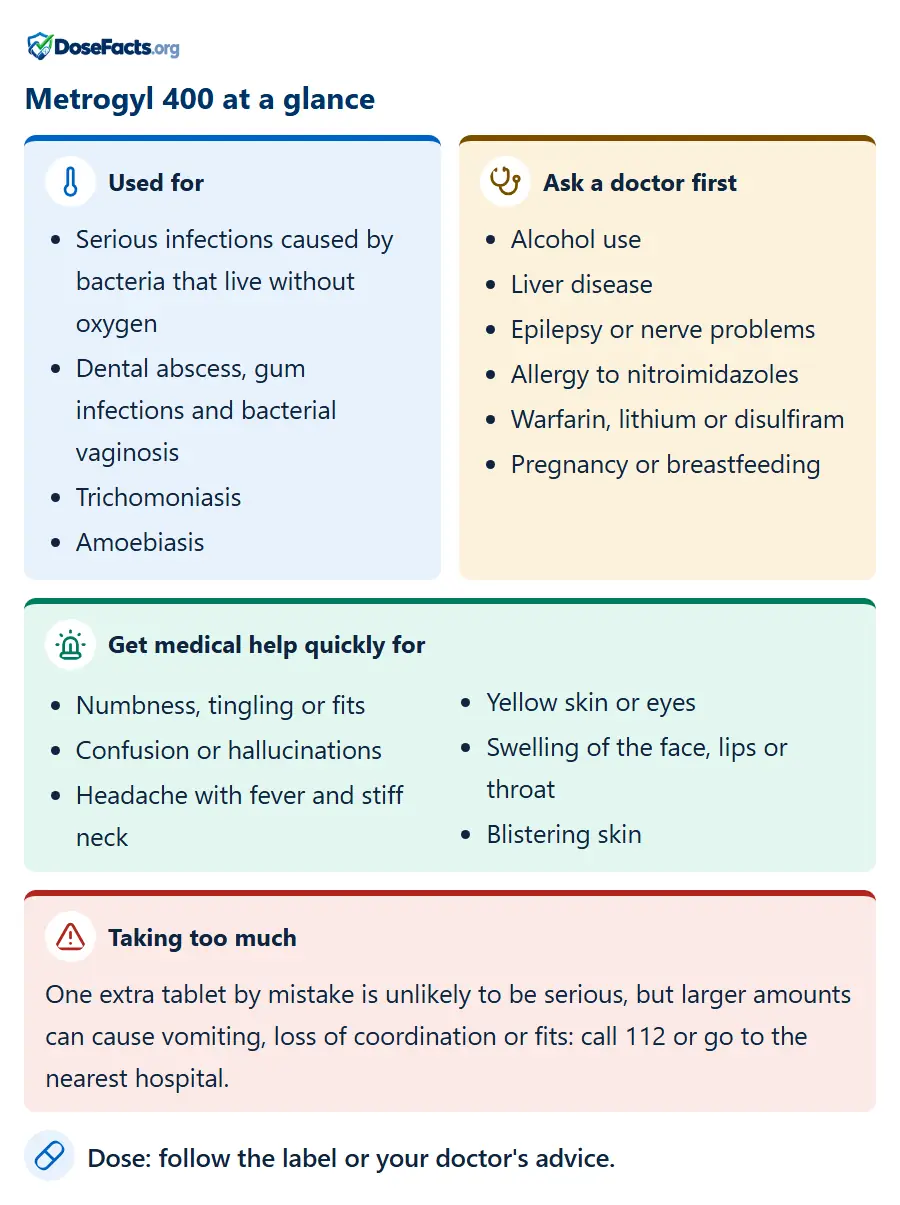
Metrogyl 400 is a prescription medicine. It is used, on a doctor's advice, to treat certain infections caused by bacteria that live without oxygen and by some parasites.
- Treating serious bacterial infections caused by bacteria that live without oxygen, such as some infections in the abdomen, pelvis, skin, bones, lungs and brain
- Treating dental abscess and gum infections, and bacterial vaginosis, when a doctor judges it suitable
- Treating trichomoniasis, a parasite infection passed on by sex
- Treating amoebiasis, an amoeba infection of the gut or liver
How does Metrogyl 400 work?
Inside bacteria and parasites that live without oxygen, metronidazole is changed into a form that damages their DNA, and they die. It has no effect on viruses or on bacteria that use oxygen.
What happens in your body after you take it
You swallow the tablet
The tablet dissolves in the gut and metronidazole is almost fully absorbed into the blood.
It travels in the blood
Metronidazole spreads widely through the body, including into body fluids, the liver and the brain, where anaerobic infections can sit.
It is activated inside the germs
Inside bacteria and parasites that live without oxygen, the medicine is reduced into a form that produces damaging free radicals.
The germs die
The free radicals damage the germs' DNA, so they cannot survive. Cells that use oxygen are largely unaffected.
The body clears it
Metronidazole is broken down mainly in the liver and leaves in the urine. Its half-life is about 8 hours, so it is taken two or three times a day, and the dose may be changed in severe liver disease.
How to take Metrogyl 400
Take Metrogyl 400 exactly as your doctor has prescribed or as printed on the pack. Your doctor decides the dose and the number of days, which depend on the infection and on how well your liver works.
- It is usually taken two or three times a day, as prescribed.
- Swallow the tablet with water. Follow the label or your doctor's advice about food.
- Do not drink alcohol during the course or for at least 3 days after the last dose.
- Take the full course your doctor prescribed, even if you feel better sooner.
- If you miss a dose, take it when you remember unless the next dose is nearly due; never take two together.
Side effects of Metrogyl 400
Most people take metronidazole without serious problems. Feeling sick, a metallic taste and diarrhoea are the most common side effects, but a few side effects need medical help.
Uncommon or mild
- Feeling sick (nausea) or being sick (vomiting)
- A metallic taste in the mouth or a furry tongue
- Diarrhoea
- Headache
- Loss of appetite or stomach cramps
- Dark-coloured urine (harmless)
Rare but serious: get medical help
- Numbness, tingling or burning in the hands or feet, or fits (seizures). Stop the medicine and tell your doctor straight away
- Hallucinations, confusion, speech problems, or a headache with a high temperature and stiff neck (possible brain or nerve problems). Get emergency help
- Blurred or double vision
- Yellow skin or eyes, or severe stomach pain spreading to the back (possible liver, gall bladder or pancreas problems)
- Unexpected infections, mouth ulcers, bruising or bleeding gums (possible blood problems)
- Signs of a severe allergic reaction: swelling of the face, lips or throat, difficulty breathing or collapse
- A severe skin reaction such as blistering, peeling skin or a widespread rash with fever
- A fast or irregular heartbeat or fainting
Who should be careful
Metrogyl 400 is not suitable for everyone, and the US label carries a boxed warning that it caused cancer in rodents, so it should be used only when needed. Tell your doctor about your health and your other medicines before taking it.
When the label says not to use it
- Allergy to metronidazole or other nitroimidazole medicines
- Taking disulfiram in the last two weeks
- Drinking alcohol during treatment or within 3 days after
- Cockayne syndrome
- The first three months of pregnancy when it is used for trichomoniasis
- It is used only for the infections it is prescribed for. It does not work for colds, flu or other viral infections, and unnecessary use should be avoided
- Alcohol: avoid it during treatment and for at least 3 days after, because the combination can cause sickness, stomach pain, hot flushes and a racing heartbeat. This includes alcohol in some syrups, mouthwashes and tonics
- Nerve or brain conditions, epilepsy or past fits: it can cause nerve damage and fits
- Liver disease: the medicine builds up and the dose may need to be lower. It must not be used in Cockayne syndrome, a rare inherited condition
- Allergy to metronidazole or other nitroimidazoles such as tinidazole or ornidazole
- Heart rhythm problems or a known long QT interval
- Pregnancy: it crosses to the baby; it must not be used in the first three months for trichomoniasis, and at other times only if clearly needed. Breastfeeding: it passes into breast milk; ask your doctor
- Blood tests: it can affect some blood chemistry tests; tell any doctor or lab that you take it
Medicines and things that interact with Metrogyl 400
Some medicines change the effect of metronidazole or are affected by it. Tell your doctor or pharmacist about everything you take.
- Alcohol: can cause a severe reaction with sickness, flushing and a racing heart
- Disulfiram (a medicine for alcohol dependence): can cause confusion or psychotic reactions; do not take within two weeks
- Warfarin and other blood thinners: the blood-thinning effect may increase, so your doctor may check your clotting more often
- Lithium: its level in the blood can rise to a harmful level
- Busulfan (a cancer medicine): the risk of its side effects can increase
- Cimetidine (an acidity medicine): can raise metronidazole levels
- Phenytoin, phenobarbital and similar medicines: can lower metronidazole levels
- Medicines that affect heart rhythm: higher risk of an irregular heartbeat
If someone takes too much
Taking one extra tablet by mistake is unlikely to be serious, but larger amounts can cause sickness, vomiting, loss of coordination, numbness or fits. There is no specific antidote. If someone has taken much more than prescribed, call 112 or go to the nearest hospital and take the medicine pack with you.
Storage
Store in a cool, dry place below 30 C, protected from light and moisture, in the original strip and out of the reach of children. Do not use after the expiry date. Check the pack for the exact storage instructions.
Regulatory status in India
Approved for sale in India as a prescription medicine. Single-ingredient metronidazole is not on the CDSCO list of medicines banned under section 26A of the Drugs and Cosmetics Act. Several fixed-dose combinations that pair metronidazole with other ingredients are prohibited (for example with norfloxacin, ofloxacin plus zinc, tetracycline, or furazolidone plus loperamide), so check the ingredient list on the pack. Metrogyl 400 should contain metronidazole only; confirm on the pack.
Other brands with the same medicine
Metronidazole 400 mg tablets are sold under other brand names and as generic medicines. They contain the same medicine; check the label for the strength. Several combinations of metronidazole with other ingredients are banned in India, so check the ingredient list and do not switch without asking your doctor or pharmacist.
Other strengths and forms
Metronidazole is also sold in other strengths, as liquids, suppositories, injections and as gels or creams for the skin or vagina, which are used differently. The strength and contents are printed on the pack, so check the label of the one you have.
Common questions
Is Metrogyl 400 a prescription medicine?
Yes. Metronidazole is a prescription-only medicine in India. It should be taken only if a doctor has prescribed it, and it should not be started, stopped or changed without the doctor's advice. Unnecessary use should be avoided.
Can I drink alcohol while taking Metrogyl 400?
No. Alcohol with metronidazole can cause sickness, stomach pain, flushing and a racing heartbeat. Avoid it during the course and for at least 3 days after the last dose, and avoid alcohol in syrups and mouthwashes. Ask your pharmacist if you are unsure.
Is Metrogyl 400 an antibiotic for cold, flu or viral fever?
No. Metronidazole acts only on certain bacteria that live without oxygen and on some parasites, not on viruses. Colds, flu and many fevers are caused by viruses. Taking it for them does not help and adds side effects. A doctor decides what infection you have and what you need.
Why does Metrogyl 400 leave a metallic taste?
A metallic or bitter taste, and sometimes a furry tongue, is a common harmless side effect that goes away after the course. Tell your doctor if you also have numbness, tingling, fits, confusion or a severe headache with stiff neck, which need prompt attention.
Should I finish the whole course of Metrogyl 400?
Take the full course your doctor prescribed, even if you feel better sooner, because stopping early can let the infection come back. The exception is a serious side effect or allergic reaction: stop and contact your doctor straight away. Never keep leftover tablets or share them.
Can Metrogyl 400 be taken in pregnancy or while breastfeeding?
Metronidazole crosses to the baby and passes into breast milk. It must not be used in the first three months for trichomoniasis and otherwise only if clearly needed. Tell your doctor if you are pregnant, planning a pregnancy or breastfeeding. Do not start or stop it without advice.
What should I do if I miss a dose of Metrogyl 400?
Take it when you remember, unless the next dose is nearly due, in which case skip the missed one and carry on as usual. Never take two doses together to make up for a missed one. If you often forget, ask your doctor or pharmacist for tips.
What is the difference between Metrogyl 400 and metronidazole?
Metrogyl is a brand name; metronidazole is the medicine inside it. Other brands contain the same medicine, but some products combine it with other ingredients, and several such combinations are banned. Check the strength and ingredient list on the pack.
Sources
- Metronidazole tablets: prescribing information (DailyMed label, updated January 2026). DailyMed, US National Library of Medicine
- Side effects of metronidazole. NHS (UK)
- Metronidazole. NHS (UK)
- ATC/DDD Index: J01XD Imidazole derivatives. WHO Collaborating Centre for Drug Statistics Methodology
- List of drugs prohibited for manufacture and sale through gazette notifications under section 26A of the Drugs & Cosmetics Act 1940. Central Drugs Standard Control Organisation (CDSCO)
- The Drugs Rules, 1945 (consolidated, September 2024 edition), Schedule H: prescription drugs. Central Drugs Standard Control Organisation (CDSCO)