
Budesonide: Uses, How It Works, Medicines
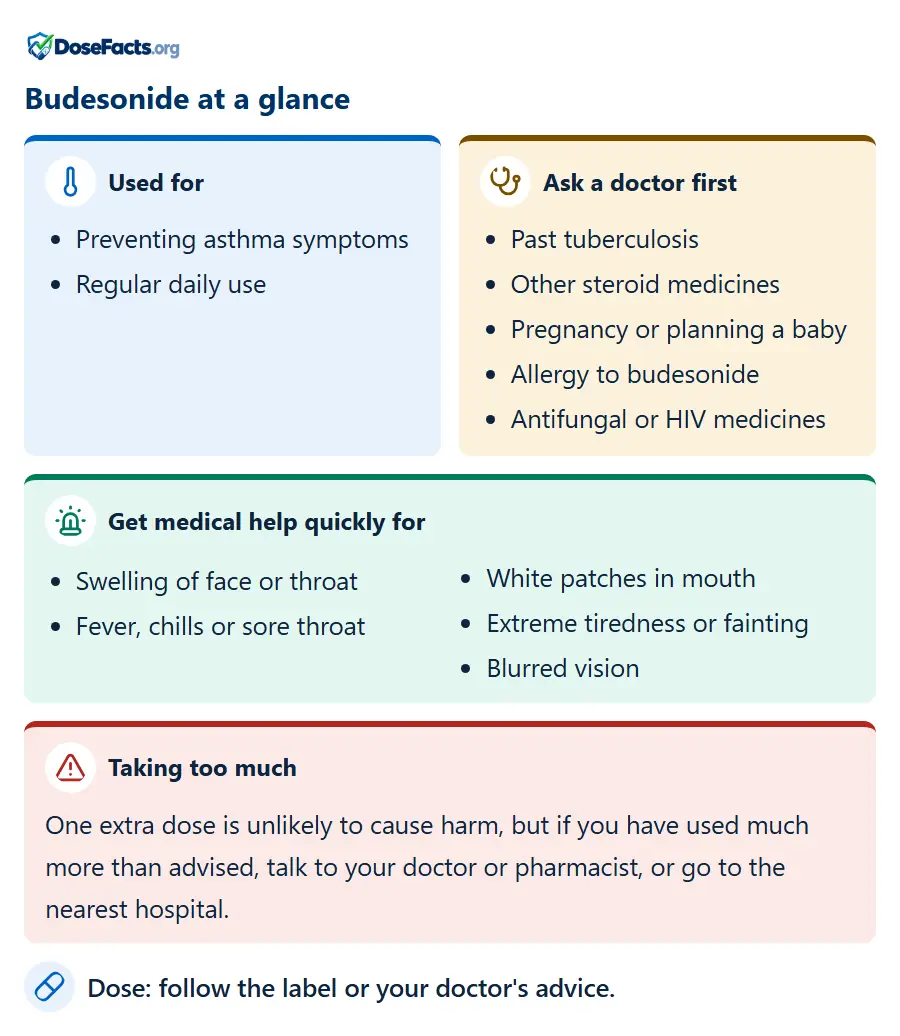
Budesonide is an inhaled steroid used as a preventer in asthma. It reduces swelling in the airways when used regularly, so that symptoms occur less often. It does not relieve a sudden attack, so a separate reliever inhaler is usually also needed. It is a prescription medicine and should not be stopped suddenly without speaking to a doctor.
Also known as: Budesonide inhaler, Budesonide steroid inhaler, Pulmicort, Budecort
Pharmacist review in progress. This page is based on the sources listed below and is being checked by our registered pharmacist.
How does Budesonide work?
Budesonide is a corticosteroid that acts directly in the lungs. It calms the swelling in the airway lining, so the airways are less sensitive and less likely to tighten.
How to take Budesonide
Follow the label or your doctor's advice. It is used regularly, even when you feel well. Follow the pack leaflet and your doctor's instructions for the inhaler technique and any spacer.
Side effects of Budesonide
Most people use inhaled budesonide without serious problems. Some side effects are common and mild, but a few need medical help.
Uncommon or mild
- Oral thrush: white patches, redness or soreness in the mouth
- Dry or sore throat
- Hoarse voice
Rare but serious: get medical help
- Swelling of the face, lips, tongue or throat, or difficulty breathing (a severe allergic reaction). Get medical help immediately
- Signs of infection such as fever, chills, a very sore throat or mouth sores that do not heal
- Vomiting, dizziness, fainting, muscle weakness or extreme tiredness (possible adrenal problems)
- Blurred vision or a cloudy lens (possible eye problems)
Who should be careful
Some people need to check with a doctor before using budesonide, or need extra care while using it.
When the label says not to use it
- Allergy to budesonide or any ingredient of the inhaler
- As a reliever for a sudden asthma attack
- It does not relieve a sudden attack: keep your reliever inhaler with you, and get emergency help if breathing is very difficult
- Do not stop it suddenly; talk to your doctor or nurse first
- Past tuberculosis (TB), or taking or having recently taken other steroid medicines
- Allergy to budesonide or any ingredient of the inhaler
- Pregnancy or planning a baby: talk to your doctor
- Children on higher doses have their height and weight checked; adults on high doses for a long time may need monitoring
- Rinse your mouth with water or brush your teeth after each use, and follow the pack leaflet for technique
Medicines and things that interact with Budesonide
Budesonide can be used with many medicines, but a few change its effect. Tell your doctor or pharmacist about everything you take, including other steroids and herbal remedies.
- Other steroid medicines (tablets, injections, creams): the total steroid effect may be higher
- Some antifungal medicines such as ketoconazole and itraconazole, and some HIV medicines: they can raise the level of budesonide in the body
- Other breathing medicines: ask your doctor before changing how you use them
If someone takes too much
Using too much budesonide at one time is unlikely to cause harm. Using much more than advised over a long time can cause steroid side effects. If you are worried, talk to your doctor or pharmacist, or go to the nearest hospital and take the inhaler with you.
Regulatory status in India
Approved for sale in India as a prescription medicine (Schedule to be confirmed from the pack). Single-ingredient budesonide was not found on the CDSCO list of medicines banned under section 26A of the Drugs and Cosmetics Act. Combination inhalers contain other medicines too, so check the ingredient list on the pack.
Type of medicine
Budesonide belongs to this type of medicine.
Medicines that contain Budesonide
These medicines sold in India contain Budesonide. They are listed A to Z, not ranked.
- Budecort 200 · 200 mcg per puff inhaler
What is Budesonide used for?
Medicines that contain Budesonide are used for these conditions.
Common questions
What is budesonide used for?
Inhaled budesonide is a steroid preventer used regularly to reduce airway swelling and lower the chance of asthma symptoms. A doctor decides whether it suits you and how it should be used.
Is budesonide a reliever?
No. It works over days and weeks and does not stop a sudden attack. Keep your reliever inhaler for sudden symptoms, as your doctor advised, and get emergency help if breathing is very difficult.
Why should I rinse my mouth after using it?
Some medicine stays in the mouth and throat and can cause thrush, soreness or a hoarse voice. Rinsing with water or brushing your teeth after each use may help. Tell your doctor if you see white patches in your mouth.
Can I stop budesonide when my asthma is better?
Do not stop on your own. Feeling better usually means it is working, and stopping suddenly can bring symptoms back. Talk to your doctor or nurse, who decides whether any change is suitable.
Is Budecort the same as budesonide?
Budecort is a brand name for inhalers containing budesonide. Check the strength and device on the pack. Some inhalers contain budesonide together with another medicine, so check the ingredient list before switching.
Sources
- About budesonide inhalers. NHS (UK)
- Who can and cannot use budesonide inhalers. NHS (UK)
- Common questions about budesonide inhalers. NHS (UK)
- How and when to use budesonide inhalers. NHS (UK)
- Side effects of budesonide inhalers. NHS (UK)
- ATC/DDD Index: R03BA Glucocorticoids. WHO Collaborating Centre for Drug Statistics Methodology