
Otrivin: Uses, How It Works, Side Effects
Also known as: Otrivin nasal drops, Otrivin nasal spray, Otrivin adult nasal spray, Otrivin 0.1%, Xylometazoline 0.1% nasal
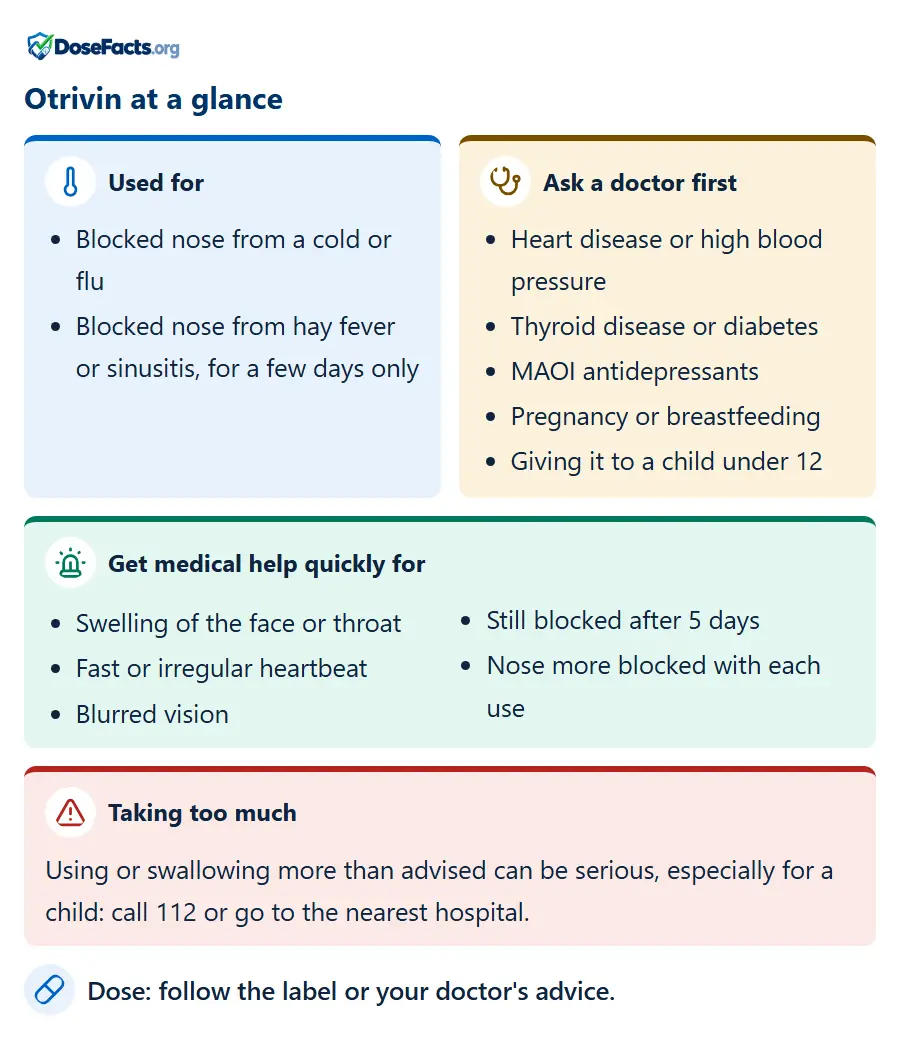
Otrivin is a nasal decongestant containing xylometazoline 0.1%, used to relieve a blocked nose from colds, hay fever and sinus problems. It works within minutes but is for short use only, no more than 5 consecutive days. Longer use can make the blockage return or worsen.
- Active ingredient
- Xylometazoline 0.1% w/v (VERIFY on pack)
- Type of medicine
- Nasal decongestants
- Starts working in
- Within minutes of using it in the nose
- Effect lasts
- Several hours; use only as the pack says and for no more than 5 consecutive days
- With or without food
- Not applicable: it is used in the nose
- Alcohol
- No known problem with the drops; follow the label
- Pregnancy
- Ask a doctor first before using it in pregnancy or while breastfeeding
- Habit-forming
- Not addictive, but repeated use can make the nose depend on it (rebound congestion)
- Made by
- VERIFY on pack
Pharmacist review in progress. This page is based on the sources listed below and is being checked by our registered pharmacist.
On this page
What is Otrivin used for?
Otrivin is used for short-term relief of a blocked nose. Check the pack for the uses printed on it.
- Relieving a blocked nose from a cold or flu
- Relieving nasal congestion from allergic rhinitis (hay fever) or sinusitis, for a few days only
How does Otrivin work?
Xylometazoline narrows the small blood vessels in the lining of the nose, so the swelling goes down and air can pass more easily. The effect fades after a few hours, and the vessels can swell again, sometimes more than before.
What happens in your body after you take it
You apply it in the nose
Drops or spray are put into each nostril as the pack directs, after gently clearing the nose.
It tightens the blood vessels
Xylometazoline acts on the receptors in the blood vessel walls of the nose lining and makes them narrow.
The swelling goes down
With less swelling, the nasal passages open and breathing through the nose gets easier within minutes.
The effect wears off
After some hours the vessels widen again. Used for many days, the lining can swell back worse than before (rebound congestion), which is why use is limited.
How to take Otrivin
Follow the label or your doctor's advice. Use Otrivin for the shortest time needed, and not for more than 5 consecutive days unless your pack says otherwise.
- Use only the number of drops or sprays and the number of times a day stated on your pack.
- Gently clear your nose first; do not exceed the number of uses a day.
- Do not use it for more than 5 consecutive days. If you are still blocked, talk to a doctor or pharmacist.
- Do not share the bottle, to avoid spreading infection; wipe the nozzle after use.
- Do not use the adult strength in children under 12; children's products have a lower strength.
Side effects of Otrivin
Most people have no problems when Otrivin is used for a few days, but some side effects occur.
Uncommon or mild
- Dryness or irritation inside the nose
- Headache
- Nausea
- Burning or stinging after using it
- Nosebleed (uncommon)
Rare but serious: get medical help
- Swelling of the face, lips, tongue or throat, or difficulty breathing (a severe allergic reaction). Get medical help immediately
- A fast or irregular heartbeat, or blurred vision
- A nose that gets more blocked the more you use it (rebound congestion)
- A blocked nose that does not improve after 5 days, or gets worse
Who should be careful
Otrivin is easy to buy, but it is not right for everyone, and it must not be used for long.
- Do not use for more than 5 consecutive days; longer use can cause rebound congestion and a long-lasting nasal condition called rhinitis medicamentosa
- Not for children under 12 in the adult strength
- Do not use it with MAOI antidepressants or within 14 days of stopping them
- Ask a doctor first with heart disease, high blood pressure, an overactive thyroid, diabetes, enlarged prostate, narrow-angle glaucoma or after recent brain or pituitary surgery
- Pregnancy and breastfeeding: ask a doctor first
- Allergy to xylometazoline or other decongestants: do not use it
- A blocked nose with high fever, facial pain, or lasting more than about 3 weeks needs a doctor
Medicines and things that interact with Otrivin
Otrivin can interact with some medicines. Tell your doctor or pharmacist about everything you take, including medicines for depression.
- MAOI antidepressants: do not use it with these or within 14 days of stopping them
- Tricyclic and tetracyclic antidepressants: ask a doctor first
- Other decongestants taken by mouth or in the nose: using several together raises the risk of fast heartbeat and high blood pressure
- Medicines for high blood pressure: decongestants can reduce their effect; ask a doctor
If someone takes too much
Using the nose spray or drops more often than directed can cause a fast heartbeat, high blood pressure, sweating or drowsiness. Swallowing it, especially by a child, can be serious. If someone has used or swallowed more than advised, call 112 or go to the nearest hospital and take the pack with you.
Storage
Store below 25 C, protected from heat, with the cap closed, and out of the reach of children. Do not use after the expiry date, and do not use the bottle for more than 28 days after opening (UK leaflet); check your pack for the exact instructions.
Regulatory status in India
Approved for sale in India. Single-ingredient xylometazoline is not on the CDSCO list of medicines banned under section 26A (checked in the extracted list text). Otrivin contains xylometazoline only. Children's strength products (0.05%) are different and are not described here.
Other brands with the same medicine
Xylometazoline nose drops and sprays are sold under other brand names and as generics, in 0.1% for adults and 0.05% for young children. Check the strength on the label, and do not use the adult strength for children.
Other strengths and forms
Xylometazoline is sold as drops and sprays, in adult (0.1%) and children's (0.05%) strengths, and in combination with other medicines in some products. The strength and contents are printed on the pack, so check the label of the one you have.
Common questions
For how many days can I use Otrivin?
No more than 5 consecutive days. In April 2026 the UK regulator MHRA limited xylometazoline and oxymetazoline nasal products to five days because longer use can cause rebound congestion. Follow your pack, and if you are still blocked, see a doctor or pharmacist.
What is rebound congestion?
It is a blocked nose that gets worse as the effect of the spray wears off, after using it for too long. It can feel like the original cold, so people use more, making it worse. Stop and speak to a doctor or pharmacist if this happens.
Can children use Otrivin?
The adult 0.1% strength is not for children under 12. Children's products have a lower strength and their own age limits printed on the pack. Do not give a child any decongestant without checking the pack or asking a doctor.
Is Otrivin safe in pregnancy?
Ask a doctor before using it in pregnancy or while breastfeeding. Decongestants can affect blood vessels throughout the body. A doctor or pharmacist can advise on what suits you, and may suggest salt-water nose rinses.
Who should not use Otrivin?
Do not use it if you are allergic to it, or take an MAOI antidepressant or stopped one in the last 14 days. Ask a doctor first with heart disease, high blood pressure, thyroid disease, diabetes, enlarged prostate or narrow-angle glaucoma.
Sources
- Recommended use of some nasal decongestant sprays limited to five days by UK regulator. GOV.UK (MHRA), 30 April 2026
- Otrivine Adult Nasal Drops (xylometazoline hydrochloride 0.1% w/v): patient information leaflet (revised 2/2024). Haleon UK, via the electronic medicines compendium (UK)
- List of drugs prohibited for manufacture and sale through gazette notifications under section 26A of the Drugs & Cosmetics Act 1940. Central Drugs Standard Control Organisation (CDSCO)
- ATC/DDD Index: R01AA07 xylometazoline. WHO Collaborating Centre for Drug Statistics Methodology